)
)
The Strategic Advantage: Turning Threats into a Competitive Edge
In today's interconnected world marked by volatility, uncertainty, complexity, and ambiguity, the ability to navigate disruption separates industry leaders from the rest. Resilience is no longer just about protection—it's a strategic engine for performance, stakeholder trust, and long-term value creation.
The most forward-thinking organizations are now engineering resilience to gain an unbeatable competitive advantage: the capacity to operate with confidence where others hesitate, to adapt with speed where others falter, and to seize opportunity within chaos. Success demands mastery of the three critical threat vectors reshaping our world.
Three Threat Vectors Defining Our Era
Organizations face a wide spectrum of risks, but they converge into three fundamental categories that define the modern threat landscape: human-made threats, technological threats, and environmental threats. Understanding and preparing for these vectors is not optional—it is the foundation of competitive resilience.
1. Human-made Threats

Geopolitical tensions, socio-political instability, and economic crime.
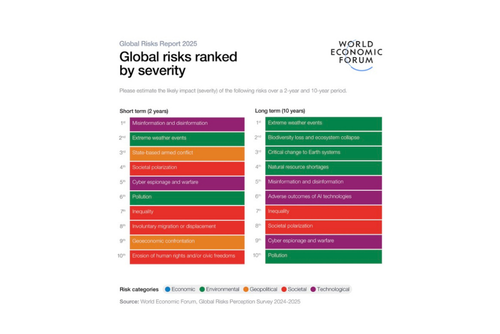
Armed conflict currently ranks as the third highest global risk[1], with high-intensity wars ongoing in the Middle East, Ukraine, and Sudan. Gen Z protests over the last two years have led to major political changes in Bangladesh, Madagascar, Nepal, and Peru, demonstrating how youth-driven movements can rapidly destabilize established orders. Meanwhile, economic crime—from sophisticated fraud schemes to corruption networks and organized criminal enterprises—continues to erode trust, distort markets, and impose significant costs on legitimate businesses operating in affected regions.
While these adversarial forces create volatility, they simultaneously create opportunities. Organizations with developed intelligence capabilities, agile governance structures, and operationally secure systems can enter new markets when competitors retreat, protect brand integrity when others stumble, and win the trust of customers and investors precisely when it matters most.
2. Technological Threats

AI-driven systemic risk, next-generation cyberattacks, and technological dependency.
Adverse outcomes of artificial intelligence technologies rank among the top risks on a 10-year outlook, surging from 31st place in the short term to 6th place over the coming decade, according to the World Economic Forum's Global Risks Report 2025. The acceleration is stark: AI already fuels the spread of misinformation and disinformation—the top-ranked short-term global risk for the second consecutive year.
Meanwhile, Quantum computing represents one of the greatest emerging threats to encryption. Experts estimate that cryptographically relevant Quantum computers capable of breaking current encryption standards could emerge within 5 to 10 years.
These challenges born from innovation move at machine speed. Organizations that build cyber-resilient and technologically assured operations ensure unwavering continuity, outpace competitors hampered by disruption, and lead with ethical and secure innovation. In a world where technology failures cascade across.
3. Environmental Threats
Natural hazards, pandemics, and resource scarcity.
According to the United Nations, current climate policies are insufficient. The planet is on track for +3.1°C warming by 2100 compared to the 1.5°C objective established in the 2015 Paris Agreement. The consequences are already materializing: natural catastrophes are multiplying, with total disaster costs now exceeding USD 2.3 trillion annually[2]. In 2024 alone, 228 natural catastrophes were recorded, claiming 10,822 lives and causing USD 137 billion in insured losses[3].
Beyond climate change, resource scarcity—from freshwater to critical minerals—threatens supply chains and operational continuity. Pandemics, once considered rare black swan events, have proven to be recurring disruptions requiring permanent planning considerations.
These global shocks are the new baseline, not exceptional events. Companies that engineer adaptive supply chains, climate-proof critical infrastructure, and build community partnerships do not merely survive—they become more efficient, reliable, and essential to stakeholders. This strengthens their license to operate and creates pathways for sustainable growth in an increasingly resource-constrained world.
Why This Threat Categorisation Matters
Categorizing threats into human-made, technological, and environmental vectors provides tangible benefits for organizational stakeholders. Concretely, this structured approach:
- facilitates risk oversight and risk assessment processes;
- creates common language across all organisational levels for discussing complex threats;
- balances the need for comprehensive risk coverage with cognitive load management;
- provides clear framework for capital and resource allocation decisions on resilience investments;
- establishes clear accountability as each vector can be assigned to specific leads with relevant expertise;
- streamlines intelligence gathering and early warning systems around three specific domains;
- simplifies scenario planning and training strategies by focusing on vector interactions rather than infinite individual threat combinations.

How the RWN Summit addresses these threat vectors
The Resilience World Nexus (RWN) Summit provides the blueprint to build this advantage by bringing together the world's leading practitioners, innovators, and strategists who are mastering these threat vectors. By attending the RWN Summit, you will gain access to:
- Closed-door focus sessions with dedicated masterclasses providing opportunities to deep dive into specific risks with a targeted audience (e.g., “Geopolitics and you, understanding the big impact picture”, “From cyber security to cyber resilience”, “Pre-emptive analysis of risk manifestations)”;
- Actionable frameworks you can implement immediately with a specific track (“Resilience outlook: Threats & Opportunities”) which examines emerging risks and opportunities across geopolitics, climate, supply chains, and technology — helping leaders turn foresight into actionable resilience.
The Time to Act
The convergence of these three threat vectors demands an integrated approach to resilience—one that recognizes interconnections, anticipates cascading failures, and builds organizational capacity to thrive under pressure.
The organizations that emerge stronger from the next crisis will be those that prepare today. They recognize that resilience is not a defensive posture but an offensive strategy—the foundation for sustainable competitive advantage in an age of persistent volatility.
The choice is clear: engineer resilience now, or cede advantage to those who do.
This article is part of insights prepared for the Resilience World Nexus 2026 Summit. For more information on building organisational resilience, visit https://www.rwnsummit.com/.
Rundown: Organizations face a wide spectrum of risks, but they converge into three fundamental threat categories: human-made threats, technological threats, and environmental threats. Understanding and preparing for these vectors is not optional—it is the key of competitive resilience.
Key elements:
- Human-made threats have escalated with geopolitical tensions, socio-political instability and economic crime creating volatility but also opportunities.
- Technological threats emerge from AI, Quantum computing and all innovations that increase our technological dependency.
- With climate change environmental threats generate significant risks from natural catastrophes to resources scarcity for all organisations.
- The categorisation of risk into three threat vectors provides tangible benefits for organisational stakeholders.
Why it matters: The convergence of these three threat vectors demands an integrated approach to resilience—one that recognizes interconnections, anticipates cascading failures, and builds organizational capacity to thrive under pressure. The choice is clear: engineer resilience now, or cede advantage to those who do.
[1] World Economic Forum. (2025). Global Risks Report 2025. Geneva: World Economic Forum.
[2] United Nations Office for Disaster Risk Reduction. (2025). Global Assessment Report on Disaster Risk Reduction 2025: Resilience Pays: Financing and Investing for our Future. Geneva: UNDRR.
[3] Swiss Re Institute. (2025). Sigma report - Natural catastrophes: insured losses on trend to USD 145 billion in 2025. Zurich: Swiss Re Institute.