)
)
)
Tuesday | 06 October 2026
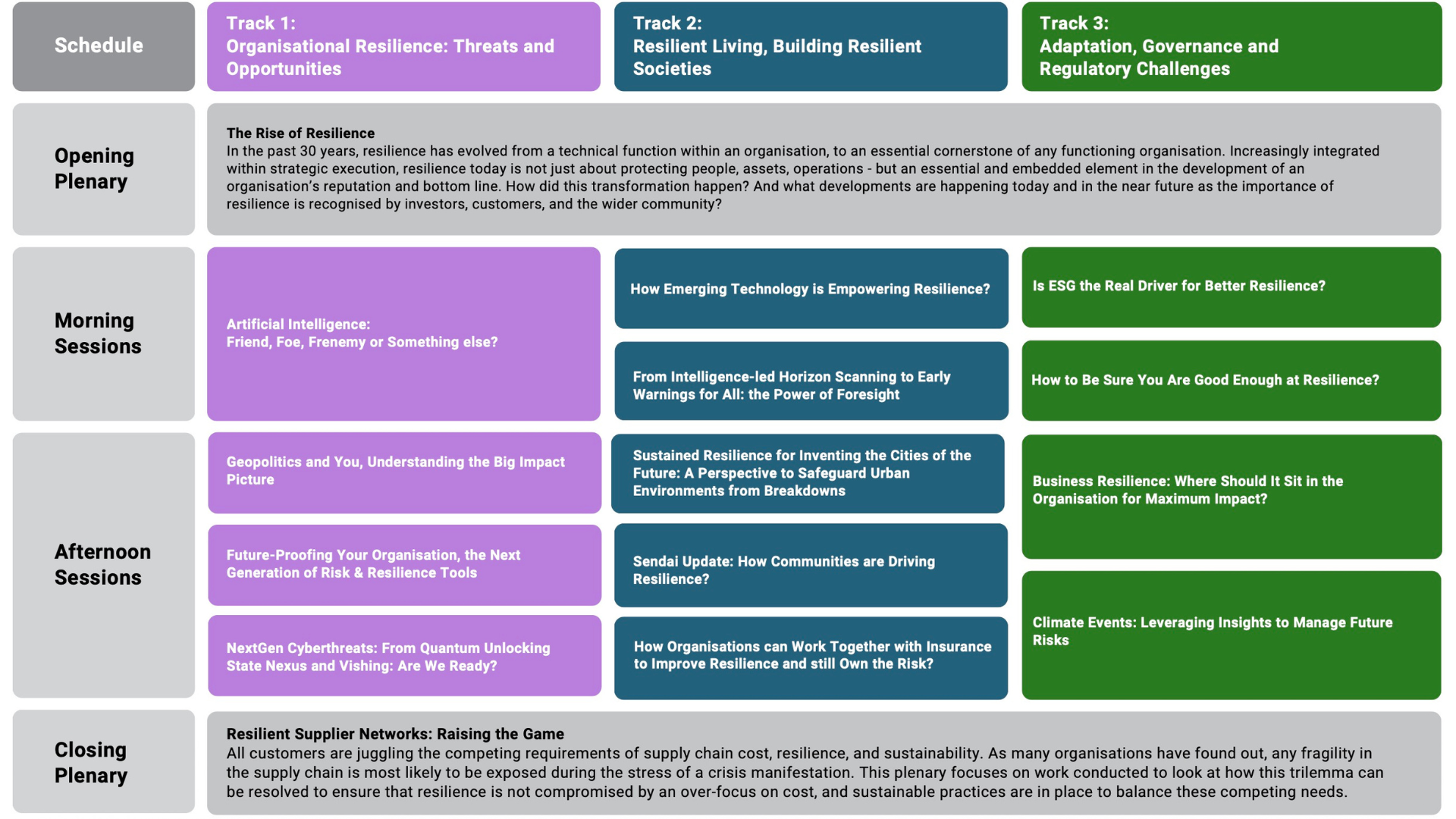
| Schedule | Track 1: Organisational Resilience: Threats and Opportunities |
|---|---|
| Opening Plenary | The Rise of Resilience In the past 30 years, resilience has evolved from a technical function within an organisation, to an essential cornerstone of any functioning organisation. Increasingly integrated within strategic execution, resilience today is not just about protecting people, assets, operations - but an essential and embedded element in the development of an organisation’s reputation and bottom line. How did this transformation happen? And what developments are happening today and the near future as the importance of resilience is recognised by investors, customers and the wider community? |
| Morning Sessions | Artificial Intelligence: Friend, Foe, Frenemy or Something else? |
| Afternoon Sessions | Geopolitics and You, Understanding the Big Impact Picture |
| NextGen Cyberthreats: From Quantum Unlocking State Nexus and Vishing: Are We Ready? | |
| Future Proofing your Organisation, the Next Generation of Risk & Resilience Tools | |
| Disease Watch: From Avian Flu to Novel Haemorrhagic Viruses: Outlook and Preparation | |
| Closing Plenary | Resilient Supplier Networks: Raising the Game All customers are juggling the competing requirements of supply chain cost, resilience and sustainability. As many organisations have found out, any fragility in the supply chain is most likely to be exposed during the stress of a crisis manifestation. This plenary focuses on work conducted to look at how this trilemma can be resolved to ensure that resilience is not compromised by an over focus on cost, and sustainable practices are in place to balance these competing needs. |
| Schedule | Track 2: Resilient Living |
|---|---|
| Opening Plenary | The Rise of Resilience In the past 30 years, resilience has evolved from a technical function within an organisation, to an essential cornerstone of any functioning organisation. Increasingly integrated within strategic execution, resilience today is not just about protecting people, assets, operations - but an essential and embedded element in the development of an organisation’s reputation and bottom line. How did this transformation happen? And what developments are happening today and the near future as the importance of resilience is recognised by investors, customers and the wider community? |
| Morning Sessions | Sendai Update: How Communities are Driving Resilience? |
| Afternoon Sessions | Sustained Resilience for Inventing the Cities of the Future: A Perspective to Safeguard Urban Environments from Breakdowns |
| Early Warnings for All: What are the Latest Tools and Techniques? | |
| How Organisations can Work Together with Insurance to Improve Resilience and still Own the Risk? | |
| Closing Plenary | Resilient Supplier Networks: Raising the Game All customers are juggling the competing requirements of supply chain cost, resilience and sustainability. As many organisations have found out, any fragility in the supply chain is most likely to be exposed during the stress of a crisis manifestation. This plenary focuses on work conducted to look at how this trilemma can be resolved to ensure that resilience is not compromised by an over focus on cost, and sustainable practices are in place to balance these competing needs. |
| Schedule | Track 3: Adaptation, Governance and Regulatory |
|---|---|
| Opening Plenary | The Rise of Resilience In the past 30 years, resilience has evolved from a technical function within an organisation, to an essential cornerstone of any functioning organisation. Increasingly integrated within strategic execution, resilience today is not just about protecting people, assets, operations - but an essential and embedded element in the development of an organisation’s reputation and bottom line. How did this transformation happen? And what developments are happening today and the near future as the importance of resilience is recognised by investors, customers and the wider community? |
| Morning Sessions | Is ESG the Real Driver for Better Resilience? |
| How to be sure you are Good Enough at Resilience? | |
| Afternoon Sessions | Meeting and Reporting Resilience Regulations: How to Supercharge Your Stakeholder Assurance? |
| Climate Events: Leveraging Insights to Manage Future Risks | |
| Measuring Resilience: Leading and Lagging Indicators for Better Performance | |
| Closing Plenary | Resilient Supplier Networks: Raising the Game All customers are juggling the competing requirements of supply chain cost, resilience and sustainability. As many organisations have found out, any fragility in the supply chain is most likely to be exposed during the stress of a crisis manifestation. This plenary focuses on work conducted to look at how this trilemma can be resolved to ensure that resilience is not compromised by an over focus on cost, and sustainable practices are in place to balance these competing needs. |
Wednesday | 07 October 2026
| Schedule | Track 1: Organisational Resilience: Threats and Opportunities |
|---|---|
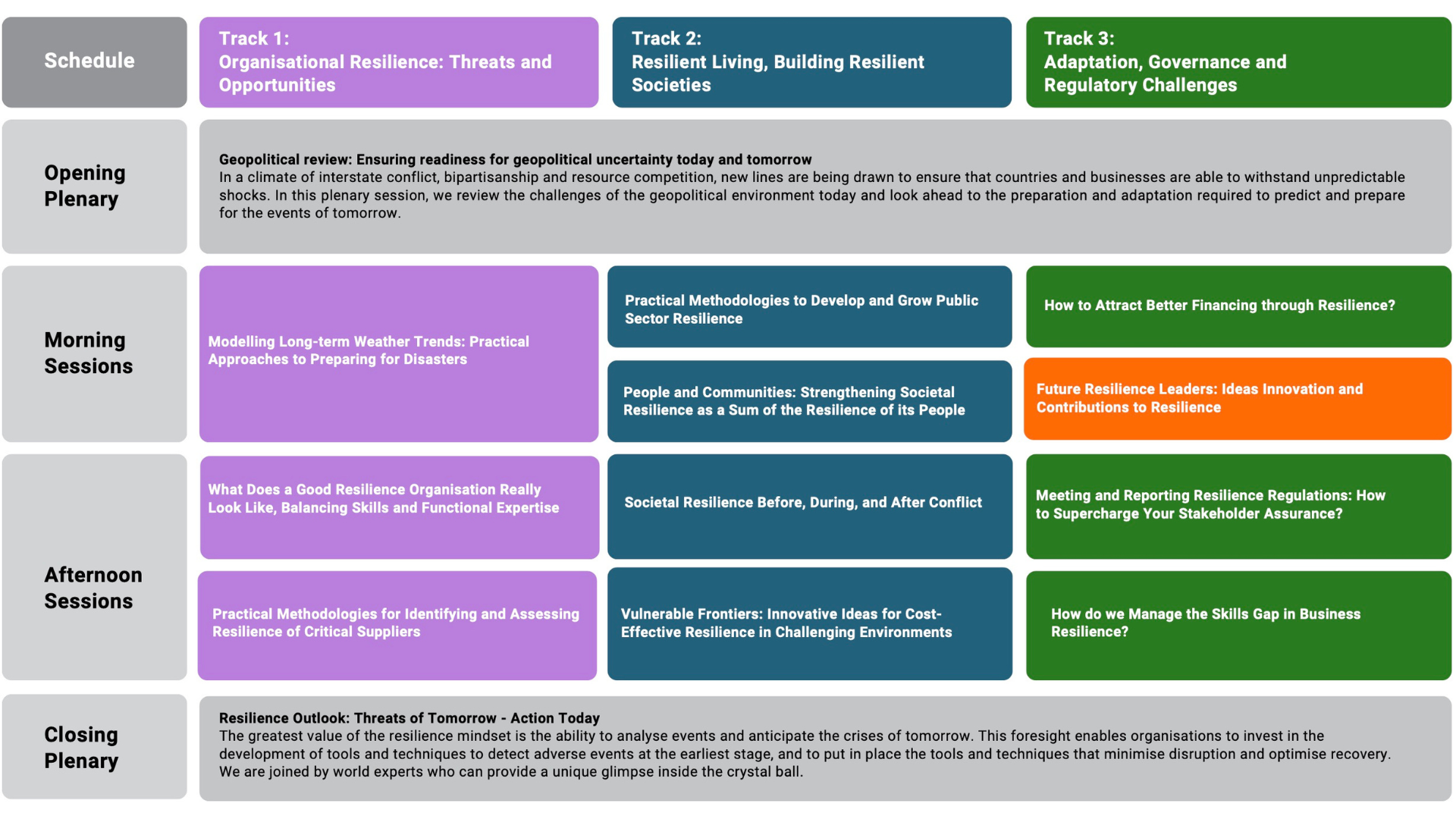
| Opening Plenary | Geopolitical review: Ensuring readiness for geopolitical uncertainty today and tomorrow In a climate of interstate conflict, bipartisanship and resource competition, new lines are being drawn to ensure that countries and businesses are able to withstand unpredictable shocks. In this plenary session, we review the challenges of the geopolitical environment today and look ahead to the preparation and adaptation required to predict and prepare for the events of tomorrow. |
| Morning Sessions | Modelling Long- term Weather Trends: Practical Approaches to Preparing for Disasters |
| Afternoon Sessions | What Does a Good Resilience Organisation Really Look Like, Balancing Skills and Functional Expertise |
| Practical Methodologies for Identifying and Assessing Resilience of Critical Suppliers | |
| How do we Manage the Skills Gap in Business Resilience? | |
| Space: From Communications, Travel, Threats, and Defence. What is the Final Frontier? | |
| Closing Plenary | Resilience Outlook: Threats of Tomorrow - Action Today The greatest value of the resilience mindset is the ability to analyse events and anticipate the crises of tomorrow. This foresight enables organisations to invest in the development of tools and techniques to detect adverse events at the earliest stage, and to put in place the tools and techniques that minimise disruption and optimise recovery. We are joined by world experts who can provide a unique glimpse inside the crystal ball. |
| Schedule | Track 2: Resilient Living |
|---|---|
| Opening Plenary | Geopolitical review: Ensuring readiness for geopolitical uncertainty today and tomorrow In a climate of interstate conflict, bipartisanship and resource competition, new lines are being drawn to ensure that countries and businesses are able to withstand unpredictable shocks. In this plenary session, we review the challenges of the geopolitical environment today and look ahead to the preparation and adaptation required to predict and prepare for the events of tomorrow. |
| Morning Sessions | Practical Methodologies to Develop and Grow Public Sector Resilience |
| People and Communities: Strengthening Societal Resilience as a Sum of the Resilience of its People | |
| Afternoon Sessions | |
| Societal Resilience Before, During, and After Conflict | |
| How to Attract Better Financing through Resilience? | |
| Resourcing and Budgeting Resilience to Optimise ROI | |
| Closing Plenary | Resilience Outlook: Threats of Tomorrow - Action Today The greatest value of the resilience mindset is the ability to analyse events and anticipate the crises of tomorrow. This foresight enables organisations to invest in the development of tools and techniques to detect adverse events at the earliest stage, and to put in place the tools and techniques that minimise disruption and optimise recovery. We are joined by world experts who can provide a unique glimpse inside the crystal ball. |
| Schedule | Track 3: Adaptation, Governance and Regulatory |
|---|---|
| Opening Plenary | Geopolitical review: Ensuring readiness for geopolitical uncertainty today and tomorrow In a climate of interstate conflict, bipartisanship and resource competition, new lines are being drawn to ensure that countries and businesses are able to withstand unpredictable shocks. In this plenary session, we review the challenges of the geopolitical environment today and look ahead to the preparation and adaptation required to predict and prepare for the events of tomorrow. |
| Morning Sessions | Assigning a Market Value to Resilience |
| What does a Good Adaptation Strategy Look Like and How Do You Know? | |
| Afternoon Sessions | Harnessing Technology to Enhance Governance and Assurance |
| Business Resilience: where should it sit in the organisation for maximum impact | |
| Balancing and Integrating Regulatory Resilience and Adaption Requirements | |
| Closing Plenary | Resilience Outlook: Threats of Tomorrow - Action Today The greatest value of the resilience mindset is the ability to analyse events and anticipate the crises of tomorrow. This foresight enables organisations to invest in the development of tools and techniques to detect adverse events at the earliest stage, and to put in place the tools and techniques that minimise disruption and optimise recovery. We are joined by world experts who can provide a unique glimpse inside the crystal ball. |